Get in Touch
Email Address
hello@creativitek.com
Phone Number
+61 423 493 386

hello@creativitek.com
+61 423 493 386

The client: ADHD Australia is Australia’s leading national charity dedicated to supporting individuals affected by ADHD. The organisation focuses on raising awareness, advocating for change, funding research initiatives, and driving positive systemic change.
Funding: National Road Safety Action Grants Program
Origin & Inspiration
The idea for this project originated when one of the interviewees in our previous augmented reality road safety project expressed how excited she was about the way our gamified AR experiences engaged and entertained her children with ADHD while teaching them about road safety. She noted that her children usually struggled to stay focused or engaged with learning activities, but with these AR experiences, they were eager to try them multiple times and were learning something valuable while having fun. Following this, we conducted further research and discovered that the road safety educational needs of children with ADHD differ somewhat from those of children without ADHD. Previous studies have also highlighted the potential of using AR for educating children with ADHD. We shared this insight and idea with ADHD Australia, who supported the concept. We then collaborated on a grant proposal, which was successfully funded by the Australian Government.
Goals
- Co-design and develop gamified augmented reality learning experiences to address the key road safety educational needs of children with ADHD.
- Assist in marketing and promoting these experiences to engage and educate a broader audience.
- Provide data and insights to help the client and funders assess the impact of the programme.
Solution
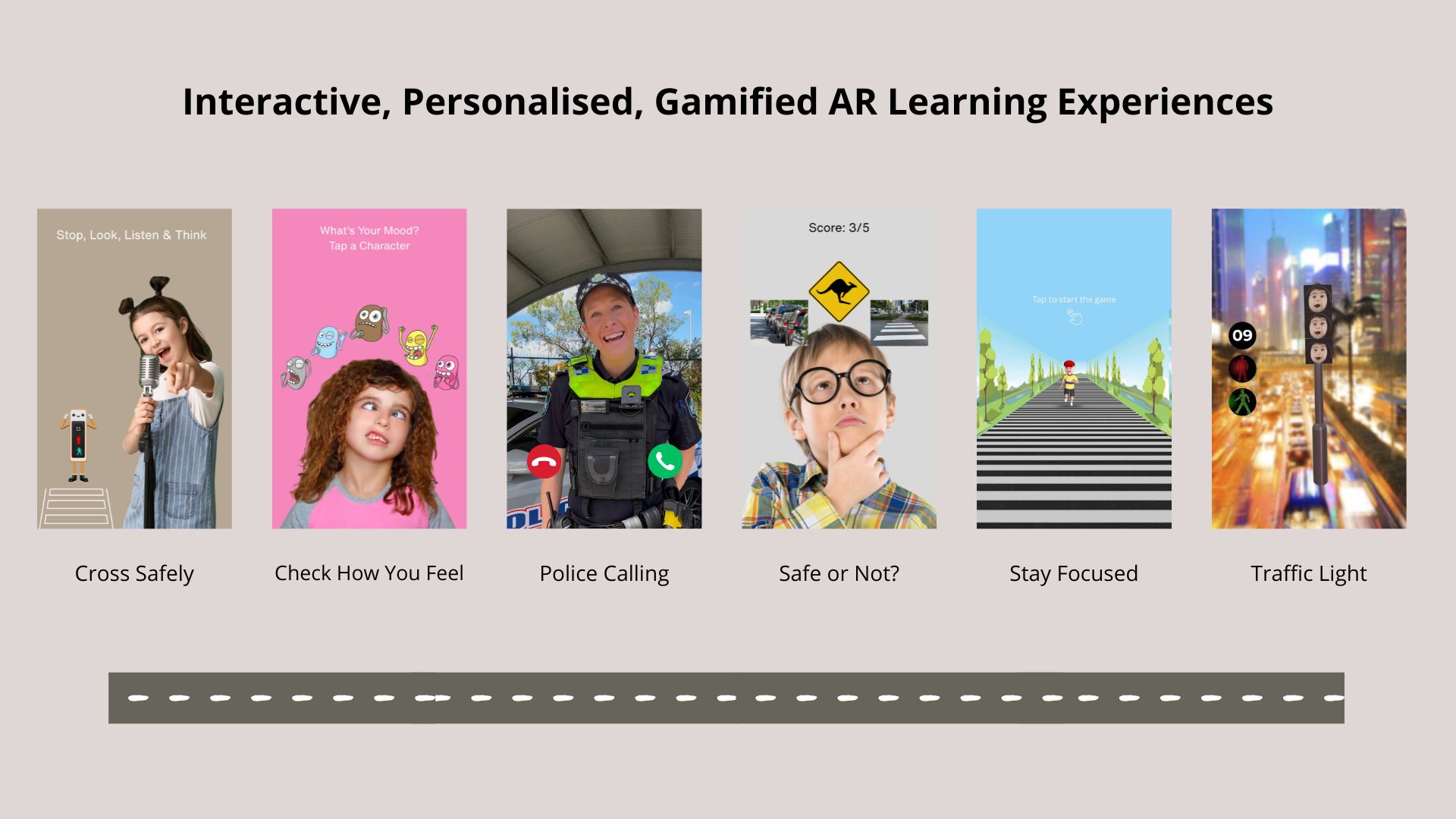
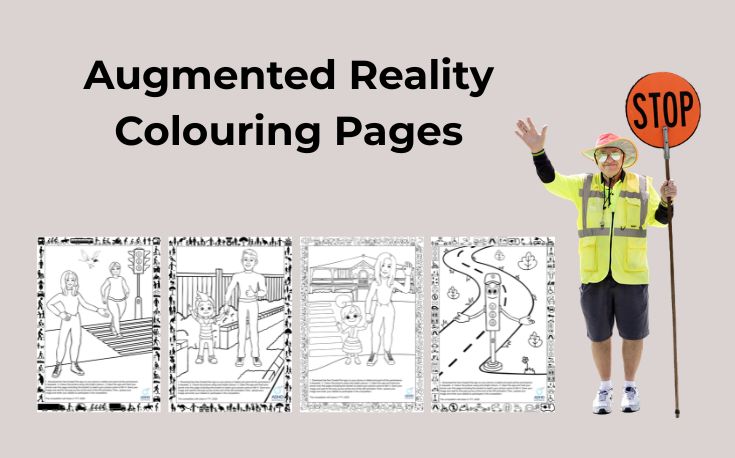
We conducted a thorough literature review to identify the road safety needs of children with ADHD and collaborated with ADHD Australia to co-design and develop four educational augmented reality colouring pages and six gamified augmented reality learning experiences.
These address general road safety topics such as identifying safe and unsafe places to cross, as well as specific needs and situations, including:
- Making decisions about crossing gaps (gap decisions)
- Timing decisions, such as determining the right moment to enter the road and allowing sufficient time to cross safely
- Managing impulsivity and road distractions
- Understanding expectations from other road users
- Developing interoceptive awareness
- Navigating daily transport routines
Below are further details about the gamified road safety learning experiences activated using QR codes:
1. Cross Safely: Users enter a fun karaoke-style environment where they sing along to a road safety song reinforcing the principles of “Stop, Look, Listen and Think”.
2. Check How You Feel: Users tap on cartoony characters whose facial expressions change to show different emotions. Through narration, they learn to recognise their own emotions and bodily signals, building interoceptive awareness and supporting safer decision-making when navigating roads.
3. Police Calling: Users receive a simulated call from a police officer. When they tap to answer, a video message educates them about staying safe around driveways and parking areas.
4. Safe or Not: Users see a kangaroo icon above their head with two images displayed on either side. A scoreboard tracks points. On-screen instructions guide users to tilt their head left or right to select safe crossing locations. Correct answers trigger a happy kangaroo animation, while incorrect choices prompt sound effects and educational feedback. Narration reinforces learning even when the correct answer is chosen.
5. Stay Focused: Users see their own faces integrated into a cartoony character within a game filled with distractions. Narration teaches strategies for staying focused near roads, followed by a mini-game at a safe zebra crossing.
6. Traffic Light: Users see their faces embedded within a traffic light character. By tapping different light colours, they learn about road rules through voiceovers in an engaging, personalised and interactive format.
Below are further details about the augmented reality colouring pages:
1. Understanding Expectations from Other Road Users and Predicting Their Intentions: Users see two 3D characters and a car come to life in the same colours they applied to the colouring page. The scene includes a zebra crossing and traffic lights, helping children learn what to expect from other road users and the importance of following road rules rather than copying others.
2. Practising Daily Transport Routines: A boy and his dad come to life while walking at a pedestrian crossing. The boy talks about his daily routine on the way to school, as additional elements appear on screen to support the storytelling. At the end, he asks users about their own daily routines and encourages them to develop a consistent routine for crossing roads during everyday activities such as walking to school.
3. The Principles of “Stop, Look, Listen and Think”: A girl and her mum come to life at the kerb, accompanied by a song reinforcing the principles of “Stop, Look, Listen and Think”. The animated 3D characters cross the road by following the instructions delivered through the song.
4. Understanding Traffic Lights: A 3D traffic light character comes to life in the same colours applied by the user on the colouring page. Through an interactive experience, children learn about different traffic light signals as the character changes colours and explains what each light means.
Outcome
Results will be provided upon project completion.
Project Acknowledgements
We sincerely thank Joanne L Philp from the Department of Transport and Main Roads and Angela Offen from the Queensland Police Service for their generous support in capturing photos and videos that contributed to the development of our augmented reality experiences.